Welcome to Iridia
Iridian Encyclopedia
History of Iridia
Iridia is a nation formed from disparate tribes that migrated to the region from the south following the fall of the Rubidim Empire in 527 PC (post calamity). Due to their advantageous trade position, these peoples interacted heavily with the Bromian culture that would go on to dominate the internal politics of the Osmic Empire.
Horseback raids from the south continued to plague the region for roughly three hundred years and several portions of northern Iridia were conquered by Bromian kings and dukes. However, the peatlands of the region were often seen as undesirable conquests, allowing proto-Iridian culture to flourish there, particularly in the village that would become Aureline, Fenwick, and Iridale.
Tribal voting to determine leadership of the area became commonplace some time in the early to mid 800s, installing leaders for life. This coincided with the spread of manorialism into the region from the north. These small warlords lobbied and coerced one another for votes, leading to factions forming and conflicts throughout the region. Inter-tribal feuds also prevented the formation of dynasties with candidates often unrelated to their predecessor. Still, trading enriched these tribes and wealth was concentrated in the hands of clans within them. These clans are the ancestors of modern Iridian nobility, although the precise genealogy was not recorded at the time.
In the year 1098 PC, an abbot named Rado founded the Autrian heresy in a monastery outside Aureline. While acknowledging the other dieties of the Rubidim pantheon, it held Autria above all else and held love to be the most critical virtue. This precipitated a rapid wave of reformations across Iridian monasteries as well as consternation in the kingdoms to the northwest and south.
This culminated in an invitation from the king of Bromia in 1107 PC, asking Rado to come to his court and guaranteeing him safe passage through Bromia. However, Rado was detained by a Bromian baron while traveling. Rado appealed to the king, citing his invitation, but the king sided with the local nobility and allowed his execution.
The news caused widespread social unrest in Iridia, with followers of Autria vandalizing and destroying the temples dedicated to other deities and attacking their clergy. Border skirmishes between Iridian and Bromian vassal also occurred. Rallying around their martyr, a series of raids on Bromian holdings were conducted by radical Autrians in early 1110 PC.
In the year 1111 PC, the king of Bromia met with religious leaders as well as clergy who had fled Iridia and declared a holy war, seeking to vassalize Iridia and cleanse both its temples and nobility of heresy. While officially staying neutral during the conflict, the kingdoms to the south and east used the opportunity to plunder regions bordering them.
The initial Bromian offensive was disastrous for the Iridians, costing them most of the northern coastlines and its ports. Using their knowledge of the fens and waterways, the Iridians were able to take several advantageous battles in the Iridian heartland before being routed in the seige of Fenwick. Aureline and Iridale fell in 1113 and the remaining lords and their levies fled to the highlands.
Here, Verdiclav Blackmere, so named for his ancestral castle, took command. Known for his even-handed judgment, Verdiclav proved to be a formidable commander. He managed to frustrate Bromian encroachment into the foothills by using deceptive tactics to draw the enemy into ambushes or unfavorable terrain. This started the counteroffensive in 1115 that recaptured Iridale and eventually pushed the Bromians out of Iridia. Despite being outnumbered and outfinanced, Verdiclav never lost a battle.
For this reason, he was made the king of Iridia and subsequently abolished the electoral system of the past, replacing it with absolute cognatic inheritence.
Iridia is a country where moral and social order are one and the same. The hierarchy is divine and just; maintaining it is more important than truth. Nobility are inherently virtuous. Peasants labor because it is their divinely appointed lot. The Temple of Autria reinforces this, its ranks filled with nobles' and wealthy merchants' children. Everything that doesn't meet the ideal is labeled a punishment at best and heresy at worst.
Each class has an ideal paradigm it must strive for. Disabilities are retribution for one's bloodline. The illegitimate are spat on. Marriage and reproduction are tools and queerness and consent are rebellion. The wealthy gain magic with temple sanction, the poor make their own deals and risk execution.
Houses of Iridia





Above, from Left to Right: The heraldry of Houses Blackmere, Lowbridge, Redwyn, Starstone, and Thistledown.
Temple of Autria
The Temple of Autria is the dominant religion of Iridia. Although part of the larger polytheistic faith tradition of the continent, Iridia has gravitated towards worshipping the goddess of love and beauty, Autria since the Autrian Heresy of 1098 PC. Worship of other gods in the pantheon is legal and small offerings are made for requests in their domain, but the Temple is the de facto state religion of Iridia and going against their word is political suicide.
Despite this power, the Temple is happy to stay out of secular affairs with a few exceptions. Most manors designate a proportion of land and taxes for serfs to give to their local temple. This has led to an accumulation of wealth that the Temple hoards behind closed doors. Second and most important, the Temple regulates under what conditions a deal may be made for greater magical power. The Temple also constitutes the largest single patron of the arts, sharing musical and visual beauty with the masses.
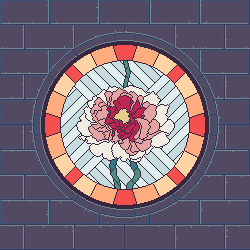
Their holy symbol is a peony.
Autrian symbolism is primarily based on flowers and the insects that pollinate them. At the center of this is the peony and the temperate leafcutter ants that suckle nectar from the opening bulbs. This religious connection to flowers has proliferated into Iridian floriography, the Iridian language of flowers. It has also affected the motifs of Iridian art, which often features bees, ants, butterflies, and other insects as well as a broad range of floral motifs. The birch tree also features prominently in the country's religious and cultural practices.
Abbeys and monasteries are sponsored by nobles across the land with abbots draw exclusively from noble families. These institutions not only serve as places for weary travelers to stay overnight, but have accumulated land over the course of centuries. Theres lands are often discontinuous, requiring delegation to local stewards, but many serfs in Iridia pay rent to a monestary or abbey. Besides these functions, they serve as hospices for the ill, centers of learning and writing, and often supply needed necessities to surrounding communities. The accumulation of wealth by monasteries and abbeys in Iridia has led to reformist movements and minor doctrinal differences.
A given temple generally is served by a priestess and a florist (male). The priestess is technically equal but in practice subservient to the florist of the temple. These are generally the roles non-inheriting children of the minor nobility are sent to an abbey or monastery. Birching is not uncommon with younger, recalcitrant youth as part of this process. Most are sent around the age of 15 and become priestesses and florists by the age of 25. Above them are Gardeners operating parishes, High Gardeners overseeing cities and counties. The head of the church is the Ivory Peony residing near Our Lady of Perpetual Beauty in Iridale.
| Flower | Meaning |
|---|---|
| Aster | Monasticism, Scholarly Pursuits, Learning |
| Azalea | Authority, Nobility, Honor |
| Camellia | Ruthlessness, Cruelty, Anger |
| Carnation | Cowardliness, Duplicity, Manipulativeness |
| Chrysanthemum | Wealth, Trade, Business Acumen |
| Forget-Me-Not | Truth, Honesty, Justice |
| Foxglove | Fear, Illusions, Madness |
| Gardenia | Rejection, Disdain |
| Goldenrod | Forgiveness, Absolution |
| Hyacinth | Innocence, Virginity, New Beginnings |
| Holly | Revenge, a Declaration of War |
| Iris | Trust, Alliance, Partnership |
| Lavender | Courage, Calm, Endurance |
| Lilac | Laziness, Indolence, Sloth |
| Lily | Moderation, Patience |
| Lily of the Valley | Grace, Humility, Beauty |
| Marigold | Excess, Imbalance, Gluttony, Greed |
| Morning Glory | Chastity, Doubles as the flower of Paramours |
| Mums | Tradition, Ecclesiasticism, Virtue |
| Pansy | Vapidness, Superficiality, Boring |
| Peony, Pink | Love, Marriage, Harmony |
| Peony, Red | Potential, Inner Strength, Resourcefulness |
| Peony, White | Intuition, Spirituality |
| Poppy | Warning, Imminent Danger, Vigilance |
| Poinsettia | Illegitimacy, Questionable Pedigree |
| Rhododendron | Magic, Spirits, Contracts |
| Rose, Red | Childhood, Playfulness, Innocent Love |
| Rose, White | Foolishness, Recklessness |
| Rose, Yellow | Surrender |
| Snapdragon | Willpower, Determination, Self-Control |
| Sunflower | Fortune, Luck, Chance, Gambling |
| Tansy | Masculinity, Virility, Physical Strength |
| Tulip | Fertility, Abundance, Femininity |
| Tulip Poplar | Hope, Faith, Renewel |
| Violet | Grief, Death, Loss |
| Waterlily | Infidelity, Disobedience, Promiscuity |
| Zinnia | Heresy, Blasphemy, Hatred |
Beauty of Autria
Beauty of Autria is a compilation of texts spanning several thousand years that serves as the canon text of the Temple. The text includes myths of the goddess herself, the chronicles of her prophets and champions, and hymns and poems dedicated to her. Though scholarship and internal discussions within the clergy agree unequivocally that the text has been edited and redacted over the centuries, that some sections claiming a single author likely were written hundreds of years apart, and that translation of the multiple languages comprising it introduce error, publicly the text is considered divinely inspired.
The inherent message is that love in all its forms is beauty. Love between spouses, love between parent and child, are love.
Love is beauty. Beauty is virtue.
This is the argument behind Iridian justice, that discipline is love, conflating it with disciplining a child described in the "Parable of the Threshing Children." In line with the religious connotations, birching is a common form of punishment in Iridia.
Laws and Governance
Iridia is a feudal kingdom with a high degree of centralized crown authority. The king and his courts act as appeals courts for the various high-justice courts of the realm (dukes and counts). These courts also retain original jurisdiction in matters such as treason, sorcery, and other crimes viewed as threats to the Iridian people and crown as a whole. Beneath the king are the high courts of the dukes and counts, who handle violent crimes, grand theft, arson, false measure, counterfeiting, and other serious crimes. Barons and individual lords handle lesser charges.
The king's council, the highest position in the realm beneath him, consist of the Marshal, Spymaster, Steward, Treasurer, Chancellor, High Magus, and Seneschal. Lower courts throughout the realm mimic this distribution of officials and 'of Iridia' is often appended to clarify the subject of conversation.
The King's Marshal not only maintains the palace and city defenses but also procures, breeds, and cares for warhorses. The King's Steward is responsible for day-to-day operation of royal lands, the keeping of records, and the settlement of minor disputes. The King's Treasurer manages the minting of coinage, works with the city council of Iridale to standardize measures for trade, and tracks the royal purse strings. The King's Chancellor manages communications between the king and his vassals as well as relations with the Temple and foreign powers. The Seneschal oversees the management of the palace and its inhabitants. The High Magus advises the king in learned matters, manages offensive and defensive magical operations, and oversees sorcery trials.
A position that doesn't exist officially but is well known, the King's Spymaster keeps an ear to the ground, collecting rumors and news. Though the spymaster is likely caught up in the schemes and intrigue of the royal court, his personal actions are shrouded in mystery. Likely endeavors include determining which vassals are likely to rebel or engage in skulduggery, engaging in skulduggery himself, and frustrating any plots from the Pricipality of Bromia.
Becoming a juror in the king's traveling or Black Tower Swordsman represents another avenue for advancement. Jurors hear appeals from cases and vote to determine the verdict, requiring a simple majority. While the king personally handles many disputes, additional groups of jurors lighten the load. The Black Tower Swordsmen are the royal guard of the Iridian Palace, spending much of their day training. They also participate in the king's name in tournaments across the continent, bringing wealth and glory home.
Iridian justice is not interested in incarceration. Most crimes are punished with fines. More serious crimes, such as those handled by the courts of the high nobility, are punished with banishment, tattooing, maiming and execution. Cases with original jurisdiction under the king's court are handled entirely via execution. Torture is not used and trial by combat is rare
Sex and Gender
- Iridian proverb
The common Iridian sentiment is that women are flowers and men are pollinating insects. This is so pervasive that 'honeybee' is shorthand for husband and 'petal' shorthand for wife. The Temple maintains a rigid gender binary and straying from it is heretical. It condemns adultery and queer relationships, these being punished by the state by tattooing. However, sex is considered a gift within the context of marriage and couples are free to engage in whatever acts they wish as long as it is between a husband and wife.
Tattoos and tattooing are heavily gendered and sexualized in Iridian society. Only women are tattooed and displaying a tattoo in public is akin to nudity. Upon coming of age, Iridian girls are tattooed on the inner thighs and lower abdomen. These designs are traditionally floral, representing a bouquet of desirable traits from Iridian floriography. Among the lowborn, these are black ink designs done by family members, usually a grandmother or other older female relative. The wealthy and nobility often pay for skilled artisans to create colorful designs.
The custom predates the Blackmere dynasty and originated in the highland regions of Iridia, but rapidly became widespread after their ascent to the throne. The folk reason given for these tattoos is that it allowed for the identification of brides kidnapped by other tribes and facilitated their return. Alongside preventing conversion, this reason is what is recorded in the chivalric poetry of Iridia in the the 1100s and 1200s. The veracity of these claims is suspect and may be only a creation of literature.
Sex workers are tattooed with a waterlily on the right shoulder. This design is done by the Temple of Autria with special, color inks that carry additional taxes, passed onto the worker as a debt. The tattoo must be kept visible via a shortened or rolled sleeve and any infection resulting from tattooing is left 'in the hands of the goddess.' The colloquial term for these workers is "waterlily women." Waterlily women are often banned from entering city limits without a waiver from a noble or their representative.
Concubinage is practiced in Iridia. The Temple of Autria has decried the practice and managed to eliminate it among the high nobility but it persists among the lower nobles. Taking the form of polygyny, these "friendwives" (the literal translation of the Iridian word) are almost exclusively lower nobles themselves. While it doesn't confer rights of inheritance to the father's property, the children are treated as legitimate and are considered members of their mother's family for the purposes of heraldy. It is often a transactional interaction between two families for the purpose of alliances.
Intersex people, referred to as the beflowered, are seen as divinely appointed to serve the Temple and are placed in specialist magical roles such as mantises. This is certainly a way to reach a different social class as a peasant but is a catastrophe for a noble house. Still there is a degree of pity around the beflowered and they are seen as having made a sacrifice in this life to serve Autria. They are the only class to have any flexibility in gender expression.
Regulation of Magic
Humans in the world of Iridia are only capable of minor acts of magic. The nature of this, often called a divine spark or sliver, is heavily debated. Acts feasible for a human include illusions in the palm of the hand, weak wards, cleaning the face or small areas of cloth, or delivering a weak shock. Any human who wishes to transcend this limitation must make a deal with a spiritual entity. The power given is proportional to what the person offers.
While the gods themselves are unreachable since the calamity, Harbingers do appear. These spirits claim to be Autria's servants and are willing to grant power simply in an exchange for an oath of loyalty to the Temple. Though more tightly regulated, the Harbingers of other accepted divinities may legally grant power as well. These are found in the Practitioners Guild, an organization of secular mages who obey and resent the clergy's demands.
The secular magical organization of Iridia with smaller outfits in urban centers throughout the country, the Practioner's Guild is the gatekeeper to anyone wishing to practice magic who doesn't wish to enter the clergy. Membership and tuition fees are steep, although apprentices of exceptional intellect or talent may have these waived if the Guild sees fit.
Deals outside these constraints are considered heresy or sorcery and are legal grounds for execution. Such crimes are treated as matters of national security and all suspects are expedited to the capital. As Temple and Practitioners Guild membership requires a noble bloodline or sufficient wealth, prosecution is often aimed across class lines.
Economy and Agriculture
Iridia's major staple crops are wheat and rye and canola is the major oil crop. Three field crop rotation and the horse collar are in use. Cabbage, carrots, and beets (which lead to vivid red peasant clothes throughout the countryside) form the next three largest harvest. Flax is grown in the lower four duchies for both fiber and oil. Vinticulture (in the south) and orchards are also present with plums and apples being the most common fruit trees. Sheep, cattle, pigs, and chickens are present with many families raising a pig to slaughter in November for winter meat. Apiaries are common in Autrian monestaries and noble estates and mead is enjoyed across the kingdom.
Iridian wetland agriculture is a response to two factors: the sacred leafcutter ants that will defoliate crops and the marshy terrain of the region. Fences of woven wood are placed in shallow bodies of water. Soil and detritus fill the enclosures until the soil is above the water level, creating an artificial island. Crops are grown on these islands, safe from the leafcutter ants. Electric catfish and crayfish are often introduced to these bodies of water if not already present, presenting another food source. Human waste is introduced to the water, creating more rich substrate to put on the artificial islands. Drier areas repel the ants via tulip poplars, a tree chosen preferentially by the colony.
The mountainous duchies of Blackmere and Crowmore house gold and iron mines as well as sapphires and rubies. This gold and silver (though much of Iridia's silver is imported) is used to mint coinage, colloquially called blooms because of the flowers on their reverse. The mineral wealth of these duchies are common flashpoints for strife among Iridia's nobility and the envy of its neighbors.
Exports that the country is known for include stained glass, the distinct geometric flowers of its textiles, and its glassblowing, often considered less luxurious than the sister culture of Stibnus but still commanding a high price. More prosperous peasant women often wear colored glass beads in their hair. Birch syrup is also produced and commands a higher price than honey.
Iridian Food
Peasants typically consume a diet of dark bread, porridge, and ale supplemented with vegetables from their garden and eggs from their hens. Crayfish, catfish, eels, and other seafood is common, though electric catfish is stigmatized as 'poor' food. These may be wild-caught or from ponds and wetland farms where they're intentionally bred. Dairy is present, although medieval cattle produce a sixth or so of the milk a modern person would expect.This is primarily made into hard cheese for storage over the winter and payment of rent
Meat is rare. Hens are only consumed only once they no longer lay and usually only during festivals and Cattle and sheep are more valuable alive than dead. A single pig may be kept by a peasant family for two years, then fattened and slaughtered a the end of November, providing meat to be pickled and smoked through the lean months. Mead and honey also make expensive yet accessible treats. Foods tend to use onions, garlic, and mustard as seasonings as these are the only spices locally and cheaply available.
The noble diet also draws from the seafood, dairy and vegetables of Iridia. However, portion sizes are larger and the bread is white. Venison and other hunted game such as rabbit is legally only on the plates of nobility. Pork, poultry, and steak are much more common as well. Plum wines, ciders, and meads also grace their tables, with red wines being present though less common. Whole bowls of honey are displayed on the table as signs of wealth. Pepper, cloves, and cinnamon are the favored spices of the Iridian nobility and the spice chest is one of the most valuable things in an Iridian estate, its key held only by the lady of the house and the seneschal.
Floral teas are consumed both religiously and in daily life. The exact mixture of flowers is diverse, varying from village to village. Apothecaries often double as herbal tea shops within cities, touting the health benefits of the flowers. Birch bark, already used make woven shoes and writing surfaces, is boiled to extract it's essential oils, which have a wintergreen-like flavor and are a common flavoring added to teas, meads and ales. Edible floral arrangements are common among nobility and clergy with rural peasants consuming a village arrangement communally during Leafcutter Day and the Peony Festival.