Heraldry Pixel Clique
Over the course of writing fiction, I've become super interested in the medieval and early modern period. Part of that for one work was creating heraldry for the major families. It was my first pixel art project that involved freehanding designs and I had a lot of fun. Pixel cliques were my introduction to pixel art, so I've decided to make my own pixel clique!
Heraldry: A Brief Discussion
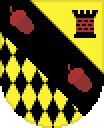
Heraldry on shields, called escutcheons, are called a coat of arms and were not just for decoration. They visually distinguished knights who were wearing platemail on a battlefield or in a tournament. Complex rules developed around heraldry because of these critical purposes. However, these rules varied from region to region. Over time, the French system began to dominate in the western half of Europe because of the popularity of French tournaments. More variety survived in eastern Europe.
The whole surface of the escutcheon is called the field. Just like pixel art, heraldry often makes use of a limited palette. Each of these colors has a technical name that enthusiasts know by heart, but I'll be using the common names for clarity. There are two metal colors, gold and silver, and five regular colors, blue, red, purple, black, and green. Metal is never supposed to be placed on metal and color is never supposed go on color. Additionally, patterns (called furs) exist and can be applied.
The field can divided up as well. It can be cut in half vertically, diagonally, or horizontally. It can also be cut into thirds or quarters. The lines used to divide the field don't have to be straight and colors can be altered, for example making a checker pattern. Broad patterns, called ordinaries can also be applied. These also come in a variety of flavors, but some examples include crosses, a square over one corner of the field, or a chevron over the middle third of the shield. These can communicate things about the family or knight, such as denoting an illegitimate birth.
Most exciting are the symbols that we actually think of when we talk about coats of arms, charges. Some charges, such as the label, are standardized for birth order such that each person in a family can have an identifiable coat of arms. While many existing charges have traditional meanings, anything can be a charge! Armor, animals, instruments, buildings, and plants can all be found as charges. The sky is the limit on charges!
There are plenty of guides online if you want to follow historical practice for your escutcheon.
All of this said, we don't live under feudalism! Feudalism sucked for a ton of reasons (merchet, filstingpound, and banal rights are topics to research if you're curious). Many of my ancestors were English and learning about English feudalism has made me appreciate how amazing it is that my family survived to the present day. Feudalism isn't something we should idealize and romanticize. Therefore, you don't have to obey any of these rules and the primary purpose of this clique is to have fun! If you learn history in the process, that's great too.
The Escutcheon Wall

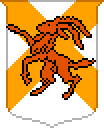
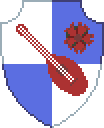

Rules
- Use the templates below or another shield shape to create a your own coat of arms. Make sure the design is 104 pixels wide and 128 pixels tall!
- Host your creation on your site, linking back to this page!
- Once you've done this, send an email with the subject "Heraldry Clique" to ImogenNocturne@proton.me with the following template:
- Name:
- Link to Your Site: (please include the link to the page you coats of arms is on if it's not the same)
- Link to Image:
- Please keep it safe for work
- Feel free to host any of the coats of arms you love! Just don't hotlink.

Setavulos made this button for the pixel clique! Feel free to use it! Check out their site as well.
Templates
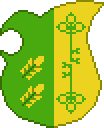
Below are some template escutcheons. If none of these speak to you, you can find more shapes here. Please just make sure that your final design is 104 pixels wide and 128 pixels tall!





Background
Here is the background I'm displaying these on if you'd like to use it!